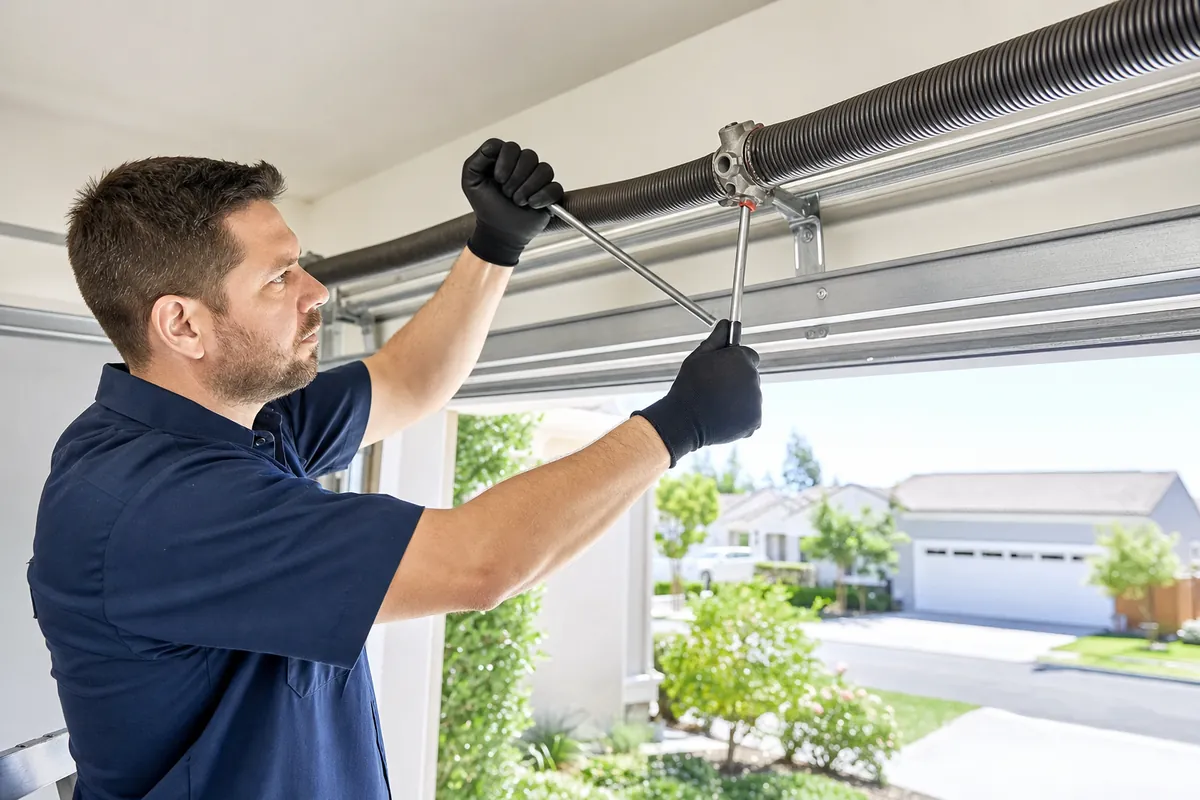

Garage Door Spring Replacement
Failed springs replaced in matched pairs and re-tensioned to the actual door weight.
View detailsCounterbalance corrected on intact springs so a wide door lifts level again.

Spring work splits into two different jobs that get used interchangeably. Repair means adjustment, re-tensioning, attention to the hardware around the spring, and correcting a balance that has drifted, and it applies where the spring itself is still sound. Replacement applies once the coil has broken, corroded or run out of useful cycle life. Balance drift turns up often in Burlington because so many doors are wide doubles: on a wide leaf a small tension error produces a visibly uneven lift, and any change in door weight has more effect than it would on a narrow single.
Springs are rated in cycles rather than in years, so a door opened six times a day uses up its allowance far faster than one opened twice, and a household that treats the garage as its main entrance, common in the Brantwell bungalofts of Tansley Woods, gets through cycles quickly. Adjustment does not put cycles back; it restores a correct setting on a spring that still has life in it. Where a coil shows separation, rust pitting or a measurable loss of output, adjusting it only defers a failure to a less convenient moment. We describe the condition found rather than quoting a generic number of years.
Work through the symptom first — some of these turn out to need no technician at all.
Springs are set for a specific weight. A replaced section, added insulation, a heavier bottom seal or a new glazed insert all change that weight, and the original setting stops being correct.
A spring loses a little torque as cycles accumulate, and cold stiffens everything around it. A door that was marginal in October can be plainly unbalanced on a January morning.
A loose centre bearing plate, a slipped cone, worn end bearings or a drum that has crept along the shaft all change effective tension without the spring itself having failed.
On a two-spring double, uneven settings or one coil further through its life than the other make the leaf lift out of square and load one track and one set of rollers far harder than the other.
Width is the Burlington factor. Tyandaga is described locally as large properties with mature streets and double-lane driveways where most homes have a double garage, Headon Forest was built with attached single- or double-car garages on lots of about 50 by 100 feet, and Millcroft homes tend to have double-car garages set back off the street. On a wide leaf, correct counterbalance is not a nicety: it is what keeps the door square in its tracks. In the townhouse-dominated parts of the city, Uptown with no detached homes at all and Tansley Woods with 41 percent low-rise condominium and 40 percent row housing, doors are narrow and light, and a suspected spring fault more often turns out to be an operator or roller problem.
Torsion springs store enough energy to cause serious injury and must be wound and unwound with proper winding bars, never with screwdrivers or improvised tools. Extension springs need containment cables so a broken coil cannot travel across the garage. Nothing in a spring system should be adjusted while the door is unsupported, and cable drums and bottom brackets remain under tension even with the door fully open. This is the part of a garage door where a small error produces a large consequence, and it is the part we would most strongly discourage anyone from experimenting with.
With the operator disconnected the door is lifted under control and tested at several heights. Its weight, its behaviour at the midpoint and whether it stays where it is left tell us what the spring is really doing.
Coil condition, gaps, cone seating, the shaft, centre and end bearings and drum position are all examined. Visible separation or heavy pitting makes a spring a replacement candidate, not an adjustment candidate.
Where the spring is sound, tension is adjusted in measured increments with the door retested by hand between them. Where it is not, we say so rather than chasing balance on a coil that is finished.
Level travel, equal cable tension on both sides and settled behaviour at rest are checked before the operator goes back on, and then its force settings and safety reversal are verified.
Failed springs replaced in matched pairs and re-tensioned to the actual door weight.
View details
Frayed or unwound lift cables renewed and re-seated on their drums.
View details
Seasonal inspection and adjustment that catches wear before it strands a car.
View detailsFill out the form and we'll confirm your appointment by email.
Garage Door Spring Repair is available across every Burlington neighbourhood inside the area below.
Map data © Google. Pin shows the service area, not a walk-in location — all work is done at your home.

A real callout, not stock imagery.
A sectional door pulled off its tracks, taken down and supported on site so it could be checked and re-hung safely — photographed on the job.