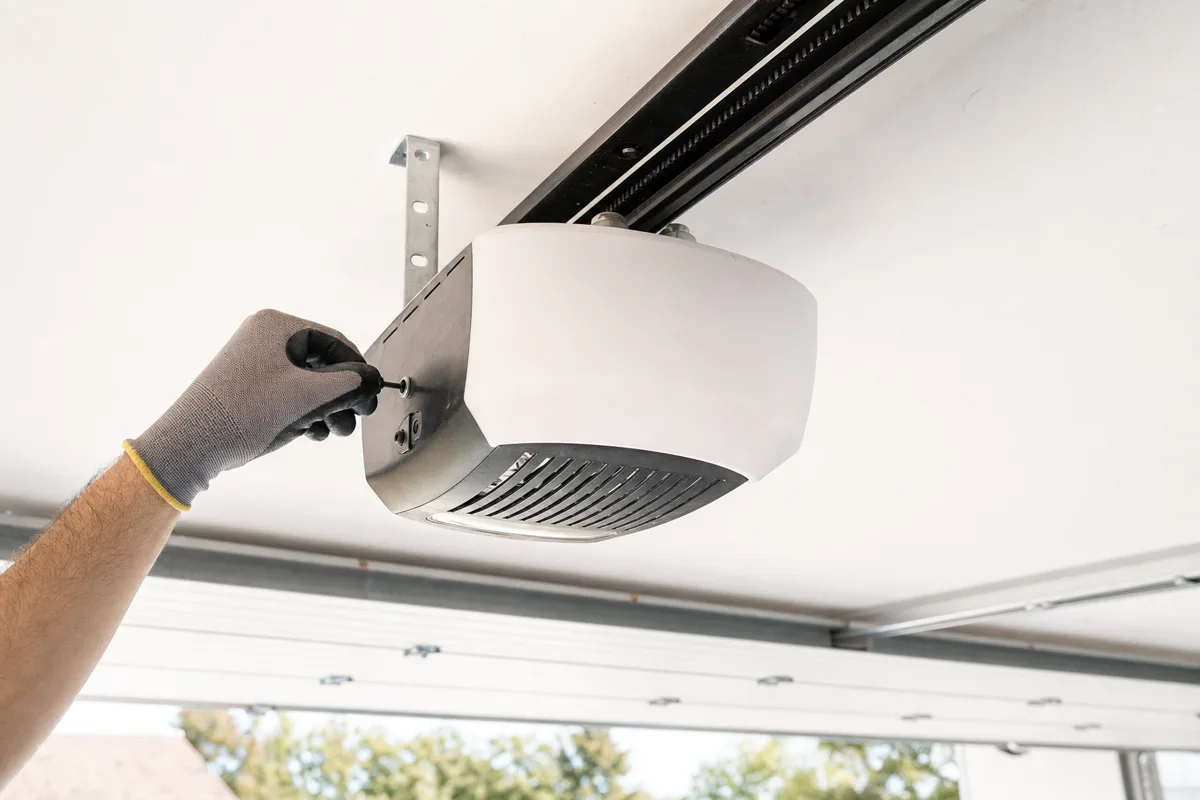

Garage Door Opener Installation
Operators sized to the door, from townhouse singles to 1970s ranch doubles.
View detailsDrive, board, limit and safety-sensor faults diagnosed before parts are changed.

An opener is a small motor doing a job that only works when the door itself is balanced. Most of the faults people describe as opener problems fall into three groups: an electronic or control issue in the unit, a safety system doing exactly what it should because something is interrupting or misaligned, or a mechanical problem in the door that the operator has been quietly compensating for until it could not. Sorting a fault into the right group before parts are discussed is most of the value of the visit, and it saves replacing a working motor.
Operators generally give a decade or more of service, and the parts that fail first are predictable: the plastic drive gear, the trolley, the chain or belt and the logic board. Which of those is worth repairing depends on availability and on what else in the unit is near its end. Where the safety reversal cannot be made to work reliably, or where the unit has no photo-eye pair at all, replacement is the honest recommendation regardless of whether the motor still turns. We will always tell you which category your unit is in rather than defaulting to a new one.
Work through the symptom first — some of these turn out to need no technician at all.
The photo-eye pair beside the opening must see each other for the door to close. A knock, a stored bin, a spider web or a dusty lens is enough to break the beam, and the door reverses as designed.
Plastic gears strip, chains loosen and stretch, belts wear and trolleys crack. A drive that has spent years pulling a door heavier than it should be gives up here first.
Limits tell the operator where the door should stop and how much resistance is acceptable. As a door's balance changes, settings that were right become wrong, and the unit stops short or reverses.
A spring losing output, a dry roller or a binding track all raise the effort needed. The motor compensates until it cannot, then trips out, and the fault presents as an electrical problem.
Duty cycle differs sharply across Burlington and it shows in operator wear. In the townhouse-heavy areas, Uptown with no detached houses and row housing at 63 percent of dwellings, and Tansley Woods where low-rise condominium and row housing together make up 81 percent, the doors are light and the operators cycle frequently, so drives, sensors and wall controls wear out long before springs do. Headroom is the other local constraint: finished, low garage ceilings are common in townhomes and in the Brantwell bungalofts, and where a conventional rail will not fit, a wall-mounted operator driving the torsion shaft is often the practical answer.
Isolate power before working inside an operator: the internal capacitor and the motor can move the drive unexpectedly, and a trolley engaging while hands are on the rail is a real hazard. Never disable a photo-eye sensor to make a door close, and never bypass a safety reversal to work around a fault, because that system exists specifically to protect children and pets in the closing path. If the reversal does not work when tested with an obstruction, the door should not be used with the operator until it does.
The operator is disconnected and the door lifted by hand. If it is heavy, uneven or will not hold position halfway, the door is the problem and no adjustment inside the unit will resolve it.
Modern operators flash diagnostic patterns and most have a documented meaning. Sensor alignment, wiring at the terminals and the condition of the wall control are checked alongside those codes.
Gears, chain or belt tension, the trolley, the rail and the arm are examined. A worn gear set is usually repairable as a component rather than requiring a whole new unit.
Travel and force are set with the door balanced, then the reversal is physically tested with an obstruction. That test is the point of the whole system and it is not skipped.
Operators sized to the door, from townhouse singles to 1970s ranch doubles.
View details
Seasonal inspection and adjustment that catches wear before it strands a car.
View details
Worn rollers, bent track and loose brackets corrected for quiet guided travel.
View detailsFill out the form and we'll confirm your appointment by email.
Garage Door Opener Repair is available across every Burlington neighbourhood inside the area below.
Map data © Google. Pin shows the service area, not a walk-in location — all work is done at your home.

A real callout, not stock imagery.
A sectional door pulled off its tracks, taken down and supported on site so it could be checked and re-hung safely — photographed on the job.