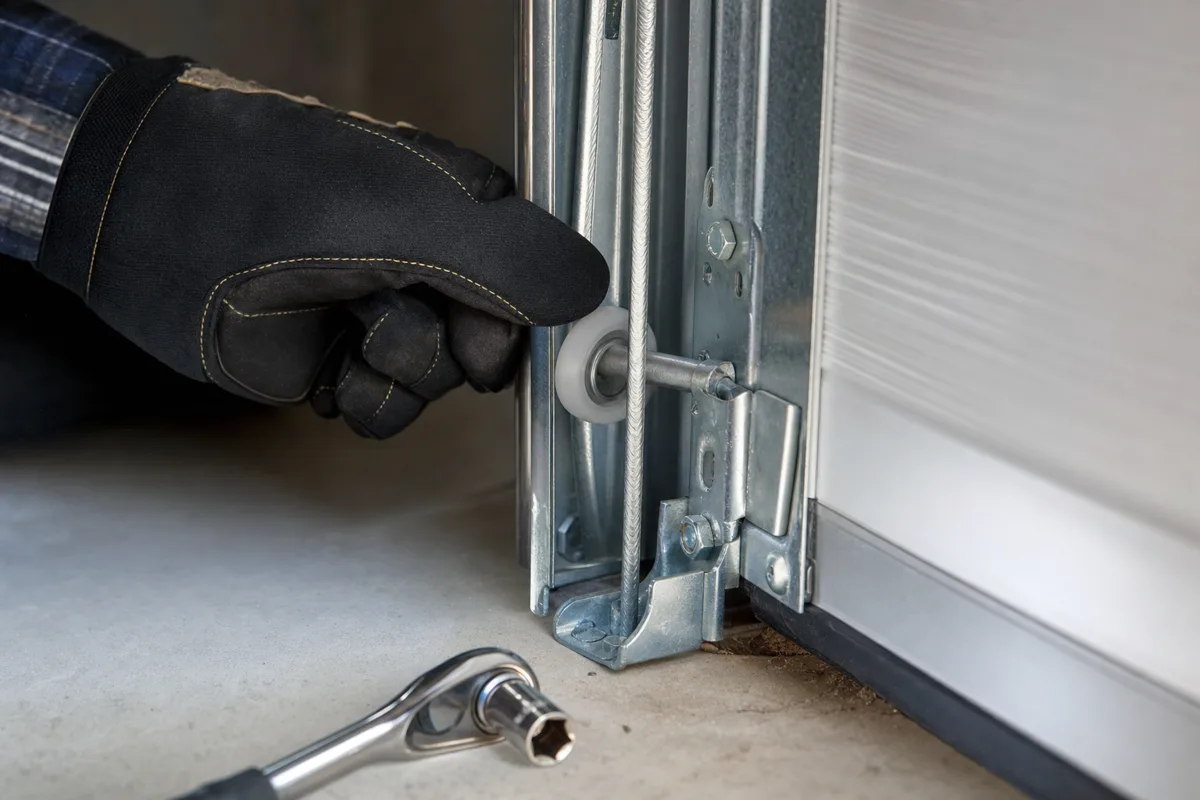

Garage Door Maintenance & Tune-Up
Seasonal inspection and adjustment that catches wear before it strands a car.
View detailsWorn rollers, bent track and loose brackets corrected for quiet guided travel.

Rollers and track are what keep a door travelling in a straight line, and they are the parts most likely to be blamed on the opener. A door that grinds, shudders, bangs at the midpoint or slaps against one jamb is almost never suffering from a motor problem: it is running on dry bearings, loose hinges or a track that has drifted a few millimetres out of line. Burlington's wide doubles make this more consequential than it sounds, because a wide leaf has more span to flex and more length of track to hold in alignment.
Roller life depends far more on lubrication and alignment than on the calendar. A well-aligned door with properly lubricated bearings can run quietly for many years, while a door binding slightly at one point will chew through rollers repeatedly and take the track with it. Steel rollers with unsealed bearings are the shortest-lived and the loudest; nylon-tyred rollers on sealed bearings are quieter and hold up better, which is a worthwhile upgrade on a garage attached to living space, as most of Burlington's split-levels and two-storey builder homes are.
Work through the symptom first — some of these turn out to need no technician at all.
Sealed and semi-sealed bearings lose their lubrication over years of cycling. The roller stops turning freely and begins to skid along the track instead of rolling, which is where the noise and the wear both come from.
Every cycle flexes the joints between sections. Screws back out of the section skin, hinge holes elongate, and the roller stem is no longer held square to the track.
Brackets shift, a vertical track gets nudged by a vehicle, or a garage frame settles. A few millimetres of misalignment is enough to make a door bind at one point in its travel.
Fine dust settles into the track and the bearings, and grit tracked in from driveways acts as an abrasive. It is a recurring issue near active construction, including the Millcroft Greens works.
Two Burlington patterns drive this work. The first is age: 62 percent of Brant Hills dwellings and 67 percent of Tyandaga's were built between 1961 and 1980, and 55 percent of Mountainside's, plus another 35 percent from 1960 or earlier, so a great deal of original guide hardware is still in service. The second is volume construction. The Orchard put 53 percent of its dwellings up between 2001 and 2005 and Alton Village 66 percent between 2006 and 2010, which means whole streets received the same builder-grade light rollers on the same schedule and now reach the same noisy end of life together. In both cases the fix is modest and the improvement is immediate.
Track work sounds harmless and is not entirely. The vertical track carries the door's weight through its rollers, and loosening the wrong bracket on a closed door with a live spring behind it can let the leaf move unexpectedly. Never remove the bottom roller bracket, which is the fitting the lift cable attaches to and which stays under tension at all times. Keep fingers out of the gaps between sections while the door is moving, because those joints close with the full force of the counterbalance behind them.
The door is cycled slowly and observed, first under power and then by hand, because the point in the travel where the noise or the hesitation happens usually identifies the offending roller or track section on its own.
Bearings are turned by hand, stems checked for wear and bending, hinge fixings tested and elongated holes noted. On a wide door the middle hinges take more flex than the ends and are inspected accordingly.
Track is brought back into line and its brackets tightened, worn rollers are replaced with the correct stem length and wheel type, and hinges that no longer hold are swapped rather than re-screwed into failed holes.
The right lubricant goes on hinges, rollers, bearings and the spring, never on the track face itself, and the door is retested for smooth level travel before the operator's settings are rechecked.
Seasonal inspection and adjustment that catches wear before it strands a car.
View details
Frayed or unwound lift cables renewed and re-seated on their drums.
View details
Drive, board, limit and safety-sensor faults diagnosed before parts are changed.
View detailsFill out the form and we'll confirm your appointment by email.
Garage Door Roller & Track Repair is available across every Burlington neighbourhood inside the area below.
Map data © Google. Pin shows the service area, not a walk-in location — all work is done at your home.

A real callout, not stock imagery.
A sectional door pulled off its tracks, taken down and supported on site so it could be checked and re-hung safely — photographed on the job.