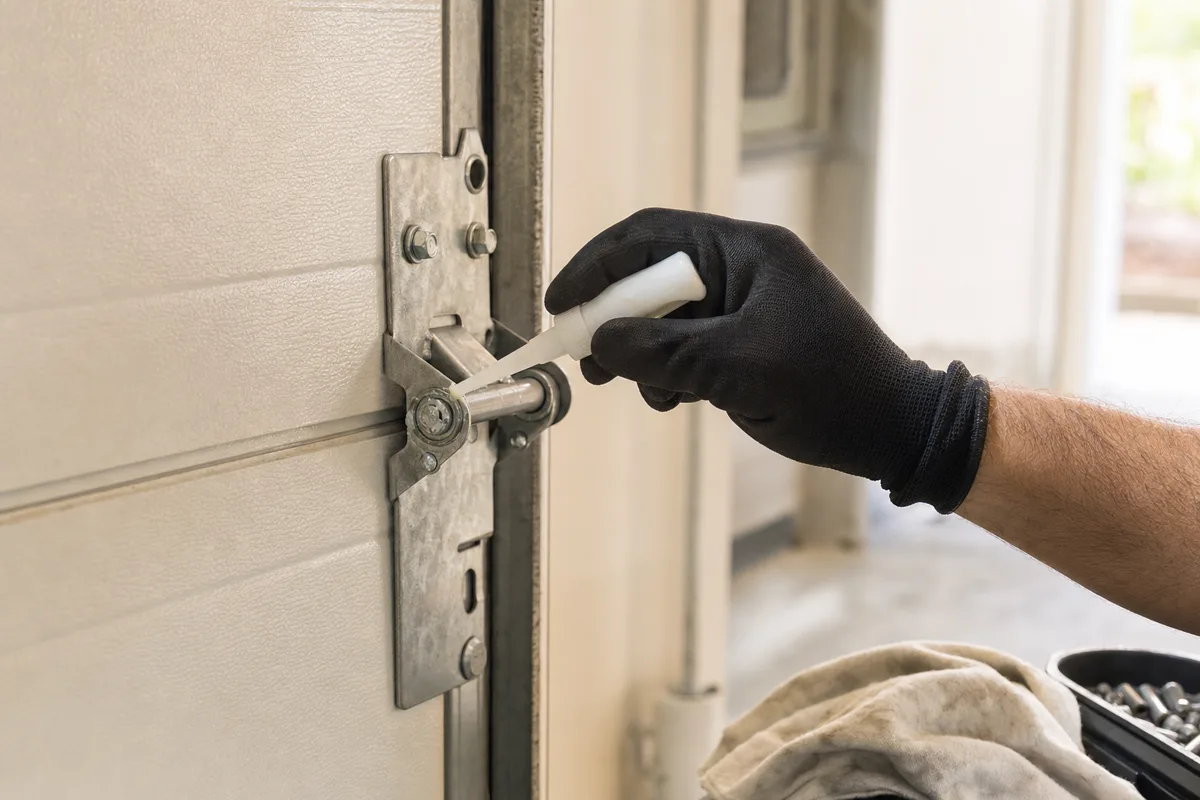

Garage Door Roller & Track Repair
Worn rollers, bent track and loose brackets corrected for quiet guided travel.
View serviceGarage doors are not silent, but they are consistent. A new sound is information, and different sounds point at genuinely different parts.
Match the sound to the part. Squealing and grinding as the door moves usually means dry roller bearings or misaligned track. Rhythmic clunking at one height means a hinge or a joint. Rattling heard through a room above generally means the operator rail and its mounts. Grinding from inside the operator points at the drive. A single bang followed by a door that will not lift means a spring has broken, and that door should not be used.
Noise is the earliest warning a garage door gives, and it is the one most easily lived with until it is expensive. The useful skill is telling the sounds apart. A dry squeal that rises and falls with the door's travel is usually roller bearings. A rhythmic clunk at the same height every cycle is a hinge or a joint. A rattle you hear through the ceiling is often the operator's rail and mounting rather than the door at all. A grinding from inside the operator housing is a drive component. And a single loud bang, followed by a door that will not lift, is not a noise problem at all but a broken spring. Burlington's stock makes some of these more likely than others: whole streets in The Orchard and Alton Village went up with the same builder-grade light rollers within a few years of each other, and they reach the same noisy end of life together.
Start at the top. The early checks are the most common causes and need no tools.
With the door fully closed, use the release and move the door by hand. If the noise is still there, it belongs to the door. If the door is quiet by hand and noisy under power, the operator, its rail and its mounting brackets are where to look.
What it means: This one test splits every noise complaint into door faults and operator faults.
With the door closed, check each roller in turn. A healthy roller spins freely with no play in its stem. One that will not turn, that grates, or that shows a flat spot or a worn stem is the source, and on a wide double the middle rollers usually wear ahead of the ends.
What it means: A roller that skids rather than rolls is the single most common cause of squealing.
Look at every hinge between sections for elongated screw holes, backed-out screws, cracked plates and worn pin holes. On a wide leaf the centre hinges take the most flex. A clunk that happens at the same height on every cycle is nearly always one of these.
What it means: Loose or worn hinges produce repeatable clunks and slowly pull sections out of line.
Stand square to the opening and look up each vertical track, then along the horizontals. Check for a bowed section, a bracket that has shifted, a gap widening between roller and track, and rub marks or metal dust that show where the door has been binding.
What it means: Rub marks and metal dust prove binding even when the door still runs.
Run the door under power and stand where you can hear the housing. A rattle from the rail, a slap from a loose chain, a whine that changes pitch under load and a grinding that continues after the door stops all point to different things inside the unit.
What it means: Grinding inside the housing with no door movement usually means a stripped drive gear.
One noise ends the diagnosis immediately. A single sharp bang, like a heavy tool dropped on concrete, followed by a door that is suddenly far too heavy or will not lift at all, means a spring has broken. Do not use the door, do not pull the release to try to lift it by hand, and keep people away from underneath it. Similarly, a grinding accompanied by a door travelling visibly out of square, or any sound coming with a slack cable, means stop. Noise that arrives with a change in how the door moves is a mechanical failure in progress, not a lubrication issue.
Volume construction is why noise complaints cluster by street in this city. The Orchard has 53 percent of its dwellings from 2001 to 2005 and Alton Village 66 percent from 2006 to 2010, so identical builder packages went in across whole subdivisions within a few years, and the light rollers used in volume installations dry out on much the same schedule. Age drives the other cluster: 67 percent of Tyandaga's dwellings and 62 percent of Brant Hills' were built between 1961 and 1980, and hardware of that vintage is well beyond its rated cycles. Width matters too, because Burlington runs so many wide doubles, and a wide leaf has more span to flex, more hinges to loosen and more track to hold in line than a single.
Fill out the form and we'll confirm your appointment by email.
These guides are written for Burlington homes. If the fix is beyond a homeowner check, we work everywhere inside this area.
Map data © Google. Pin shows the service area, not a walk-in location — all work is done at your home.

A real callout, not stock imagery.
A sectional door pulled off its tracks, taken down and supported on site so it could be checked and re-hung safely — photographed on the job.
