Home All Services
All 10 Services
Emergency Garage Door RepairGarage Door Spring RepairGarage Door Spring ReplacementGarage Door Cable RepairGarage Door Roller & Track RepairGarage Door Opener RepairGarage Door Opener InstallationGarage Door Panel ReplacementNew Garage Door InstallationGarage Door Maintenance & Tune-Up All Service Areas
All 20 Neighbourhoods
Downtown BurlingtonMaple & FreemanAldershotRoselandDynesShoreacresElizabeth GardensApplebyPinedaleLongmoorThe OrchardUptown & CorporatePalmerHeadon ForestMillcroftTansley WoodsAlton VillageBrant HillsTyandagaMountainside
Troubleshooting Guides
Diagnose a Problem
Door won't closeLoud noiseBroken spring signsFrozen shutRemote not workingOff track About Book Service

Garage Door Maintenance & Tune-Up Burlington

Seasonal inspection and adjustment that catches wear before it strands a car.

Vertical track, bottom roller bracket and lift cable at the base of a garage door, with the wall-mounted safety sensor beside the opening
What's involved

Garage Door Maintenance & Tune-Up

Maintenance on a garage door is not a euphemism for spraying lubricant and leaving. It is a sequence of specific checks with defined outcomes: is the door balanced, are the springs and cables sound, do the rollers turn, is the track aligned, do the fixings hold, does the safety reversal actually reverse. Done once a year, and ideally in autumn, it catches the failures that otherwise happen on the coldest morning of the year, when the door is under the most load and the least convenient to lose.

  • Diagnosed before quotedWe identify the actual fault rather than replacing parts on assumption.
  • Confirmed by emailSubmit the form and we reply with your appointment window and details.
Symptoms

Signs You Need This Service

  • The door has become noisier than it was a year ago.
  • It no longer holds position when raised halfway by hand.
  • The bottom seal is hardened, torn, or no longer meets the floor.
  • The opener works harder or sounds different than it used to.
  • Nothing is obviously wrong and the door has not been checked in years.

Repair or replace?

An annual check does not make components last forever; it makes their end of life predictable, which is a different and more useful thing. Springs still spend their rated cycles, rollers still wear, seals still harden. What changes is that you find out on a scheduled visit in October rather than on a January morning with a car shut in the garage. It also protects the parts around the failure: a door caught while binding slightly keeps its track and its rollers, whereas the same door left alone takes them with it.

Not sure this is your problem?

Work through the symptom first — some of these turn out to need no technician at all.

Root causes

What Actually Goes Wrong

Lubrication dries out

Roller bearings, hinge pivots, end bearings and the spring itself all depend on lubrication that eventually thins and dries. Noise is the first symptom and accelerated wear is the actual cost.

Fixings work loose with cycling

Every opening flexes the joints between sections and the brackets holding the track. Screws back out, hinge holes elongate, and alignment drifts a few millimetres at a time.

Balance drifts as the door changes

Springs lose a little output with accumulated cycles, and any change in door weight shifts the balance point. The operator absorbs the difference until it becomes a fault.

Seals and weatherstripping degrade

Bottom seals harden and split, and perimeter stops shrink. The gaps let in meltwater and grit, which is what corrodes the fittings nearest the floor.

Local conditions

Why This Matters in Burlington

Autumn is the right month in Burlington for a reason that is specific rather than generic. The January average high here is minus 0.6 degrees, essentially sitting on the freezing point, while the daily mean is minus 4.4, so garages cross zero repeatedly through the season rather than staying frozen. Seasonal snowfall is 99.9 centimetres over 25.5 snowy days, which is modest by Ontario standards thanks to Lake Ontario, but 34.2 centimetres of it lands in January alone. That pattern of daytime melt and overnight refreeze is exactly what bonds seals to slabs, corrodes bottom brackets and finds every marginal component on the door, and it is worse where a driveway falls toward the opening as it often does in Brant Hills and Mountainside.

Safety

What to Handle Yourself

The balance test is the part of this work homeowners can safely do themselves, provided the door is lowered under control and the release is only used with the door fully closed. Everything involving springs, cables, drums and bottom brackets stays under tension and belongs to someone with the right tools. The safety reversal test is also worth doing yourself once a season: place a solid object flat on the floor in the door's path and confirm the door reverses on contact. If it does not, stop using the operator until it does.

The visit

How We Work Through It

  1. Balance test by hand

    The operator is disconnected and the door lifted under control. It should move without excessive effort and hold position when left halfway, which is the single most informative test on the whole door.

  2. Full hardware inspection

    Springs, cables at the drums and bottom brackets, drums, shaft, bearings, rollers, hinges, track alignment, bracket fixings and the bottom seal are checked in sequence and reported plainly.

  3. Lubricate and adjust

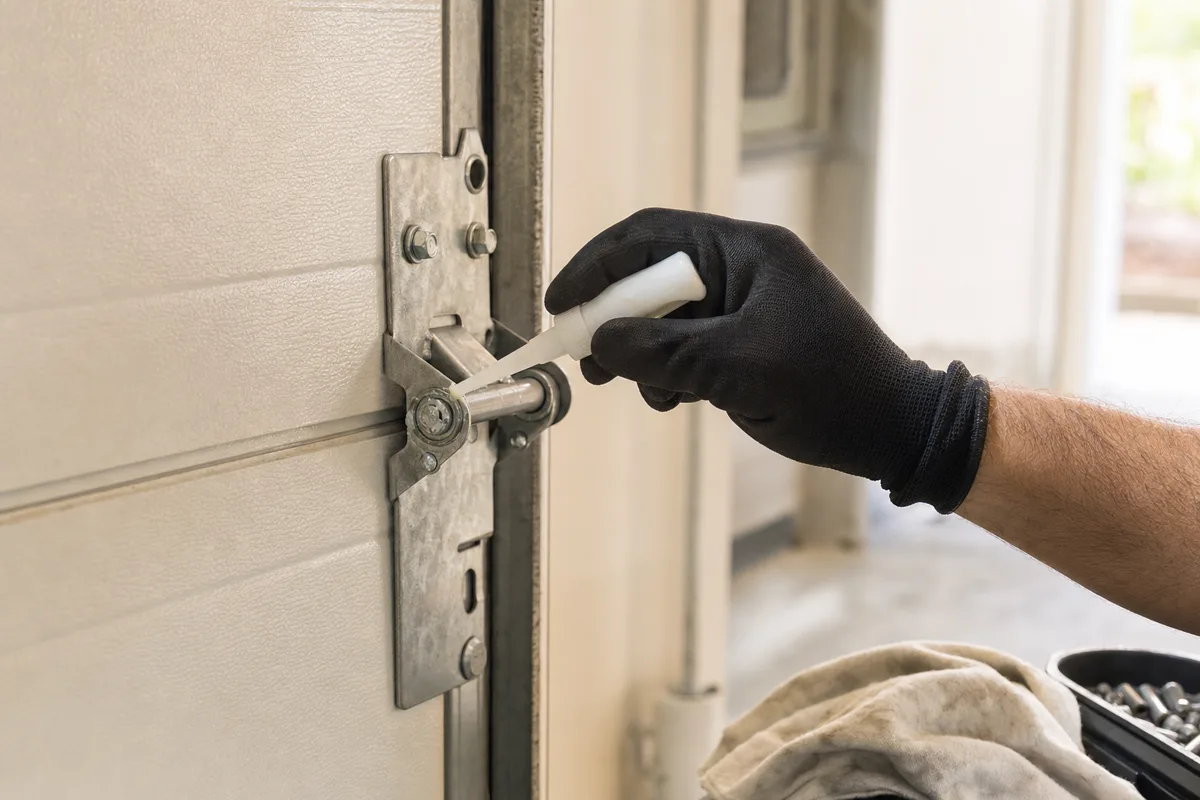
    The correct lubricant goes on bearings, hinges and the spring, never on the track face. Fixings are tightened, track brought back into line, and minor tension adjustments made where the spring is sound.

  4. Prove the safety systems

    The photo-eye pair is cleaned and aligned, force and travel limits checked, and the safety reversal tested with a physical obstruction, because a reversal that is assumed rather than tested is not a safety feature.

Related services

You Might Also Need

Centre bearing bracket and torsion spring end on a residential garage door, the shaft seated in its bearing and the bracket fixed back to the header

Garage Door Spring Repair

Counterbalance corrected on intact springs so a wide door lifts level again.

View details
Vertical track, bottom roller bracket and lift cable at the base of a garage door, with the wall-mounted safety sensor beside the opening

Garage Door Roller & Track Repair

Worn rollers, bent track and loose brackets corrected for quiet guided travel.

View details
Chain-drive garage door opener mounted to the exposed rafters of a garage, with the rail, chain and emergency release cord visible

Garage Door Opener Repair

Drive, board, limit and safety-sensor faults diagnosed before parts are changed.

View details
Questions

Garage Door Maintenance & Tune-Up FAQs

How often should a garage door be serviced?
Once a year suits most households, and autumn is the sensible month because it puts the work ahead of the season that finds every weak component. A door used as the household's main entrance, cycling five or six times a day, is worth looking at more often, and there are neighbourhoods here where that is the norm rather than the exception. A detached garage opened twice a week can reasonably go longer between visits.
What can I check myself between visits?
Three things, all safely. Disconnect the operator and lift the door by hand to see whether it holds position halfway. Place a solid object in the door's path and confirm the powered door reverses on contact. And look along the bottom seal and the last hand-span of each cable above the bottom brackets for splits, fraying or rust. Anything involving springs, cables or drums should be left to someone with winding bars.
Which lubricant should I use, and where?
A purpose-made garage door lubricant, applied to roller bearings, hinge pivots, the end bearings and the spring coil. Do not put anything on the track face, because grease there collects grit and abrades the rollers you are trying to protect. Avoid heavy general-purpose oils that attract dust, and wipe off the excess. A light annual application in autumn, before the cold, is more effective than a heavy one at any other time.
Is a tune-up worth it on a door that seems fine?
Usually, because the failures worth avoiding are the ones with no warning you would notice. A spring near the end of its cycles, a cable with broken strands at the drum wrap, or a safety reversal that has quietly stopped working all present as a door that seems fine. The check either finds something, in which case you have gained the choice of when to deal with it, or finds nothing, in which case you know where you stand.

Book Garage Door Maintenance & Tune-Up

Fill out the form and we'll confirm your appointment by email.

We confirm every request by email, usually the same day it arrives.

  • Proudly Canadian
  • Same-day service available
  • 20 Burlington communities
  • Every request confirmed by email
Request received. We'll email you a confirmed time window shortly.
Service area

Where We Work

Garage Door Maintenance & Tune-Up is available across every Burlington neighbourhood inside the area below.

Map data © Google. Pin shows the service area, not a walk-in location — all work is done at your home.

Sectional garage door pulled off its tracks and leaning inward, propped on a stepladder during a night-time emergency call, with the street lit beyond the open doorway
From the tools

A real callout, not stock imagery.

A sectional door pulled off its tracks, taken down and supported on site so it could be checked and re-hung safely — photographed on the job.