
Garage Door Spring Replacement
Failed springs replaced in matched pairs and re-tensioned to the actual door weight.
View detailsFrayed or unwound lift cables renewed and re-seated on their drums.

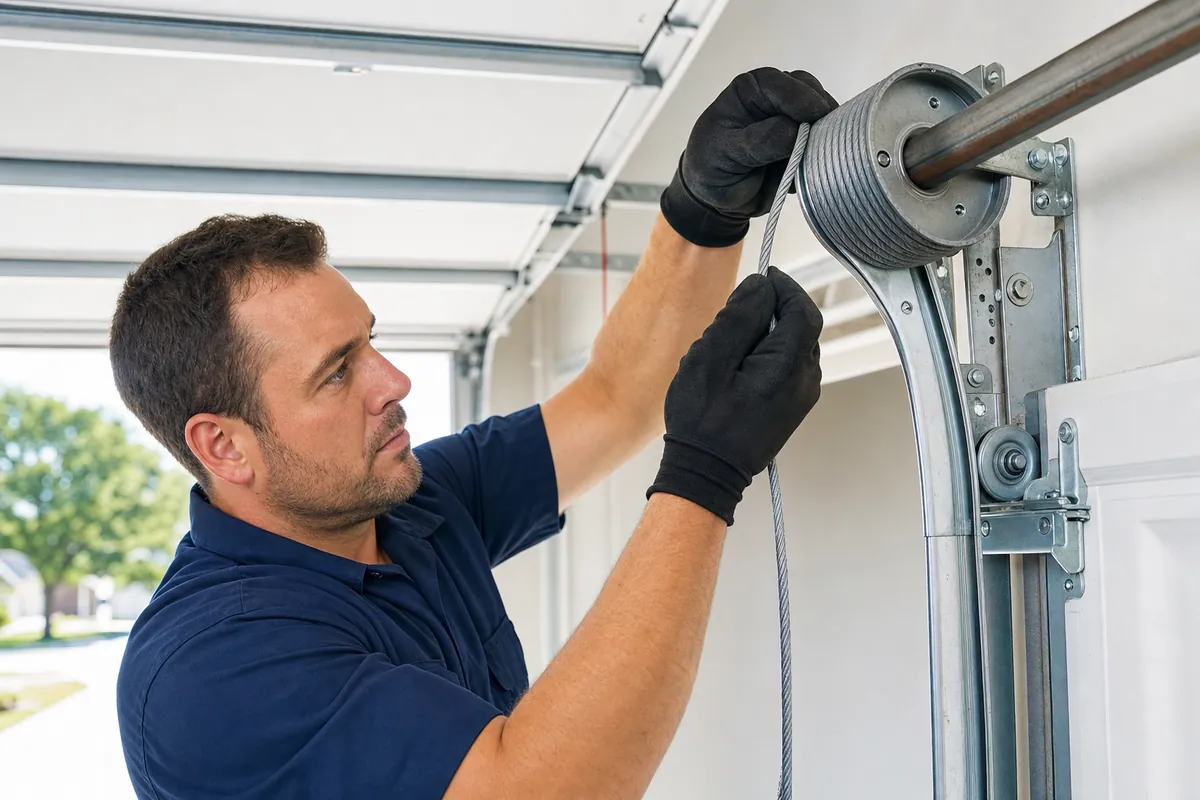
The lift cables are the quiet half of the counterbalance system. They carry the door's weight from its bottom brackets up to the drums on the spring shaft, and they do it under full tension every time the door moves. Because they are thin and unobtrusive, they are the component people overlook until one lets go, at which point the entire load shifts to one side and the door racks in its tracks. On the wide doubles that Burlington is full of, that racking is dramatic, and a leaf pulled out of square can bind hard enough to bend a section.
Cables usually outlast one set of springs and rarely two, which is why they are inspected whenever spring work is done rather than treated as a separate concern. The wear is progressive and visible: individual strands break at the wrap long before the cable parts, and a few minutes with a torch will often show it. Where a door has already had a spring failure, the cables should be regarded as having taken a shock load whatever they look like. Replacing a marginal pair during planned work costs far less trouble than replacing them after a leaf has gone out of square.
Our troubleshooting guides walk the diagnostic checks in order so you can confirm the fault before booking.
The cable bends over the same groove on every cycle, and after enough repetitions the strands at that point fatigue and begin to break. It is the single most common place a cable fails.
The bottom few inches of cable sit closest to the floor, where meltwater, grit and road salt collect. On a driveway that falls toward the door, common in Brant Hills and Mountainside, that end stays wet longest.
When a spring breaks, the cables absorb forces they were never asked for. A cable that survives the event is often damaged by it, and fails weeks later for no apparent reason.
A drum that has crept along the shaft, or a track pulled slightly out of line, makes the cable wind at an angle. It then chafes on the drum flange or the bracket edge until strands part.
The bottom of the cable is where Burlington's geography shows up. In the sloped north-west, Brant Hills sits on old tree-lined streets that follow hilly escarpment terrain and Mountainside rises toward the same escarpment, so driveways there frequently fall toward the opening and every thaw sends meltwater to the threshold. With an average January high of minus 0.6 degrees, water that arrives during the day refreezes overnight around exactly the fittings that must not seize. Add the salt and grit tracked in from the QEW and the north-south Lines, and the bottom bracket end of a cable in this city has a harder life than the top.
Cables and bottom brackets stay under spring tension even when the door is fully open, and releasing either one without controlling that tension is a genuine injury risk rather than a theoretical one. A slack cable on one side is a signal to stop using the door entirely, not to try one more cycle: the next attempt is what pulls the leaf out of square or drops it. Do not attempt to rewind a cable onto a drum by hand, and do not put fingers near a drum while the door is moving, because the wrap point will take them in.
The door is secured and the spring tension managed before anything is unbolted. A cable cannot be replaced on a live system, and a bottom bracket under tension is one of the more dangerous fittings on the door.
Cables are replaced in pairs because both have done identical work. The drums are checked for wear in the grooves, correct position on the shaft and secure set screws.
New cables are fitted, seated in their grooves and wound so both sides carry the same length and the same tension. On a wide door that equalisation is what stops the leaf leading on one side.
The door is run by hand and then under power, watching cable behaviour at both ends of travel, and the operator's force settings and safety reversal are checked before the visit closes.
Failed springs replaced in matched pairs and re-tensioned to the actual door weight.
View details
Worn rollers, bent track and loose brackets corrected for quiet guided travel.
View details
Urgent attention for doors stalled mid-travel, jammed shut or hanging crooked.
View detailsFill out the form and we'll confirm your appointment by email.
Garage Door Cable Repair is available across every Burlington neighbourhood inside the area below.
Map data © Google. Pin shows the service area, not a walk-in location — all work is done at your home.
A real callout, not stock imagery.
A sectional door pulled off its tracks, taken down and supported on site so it could be checked and re-hung safely — photographed on the job.