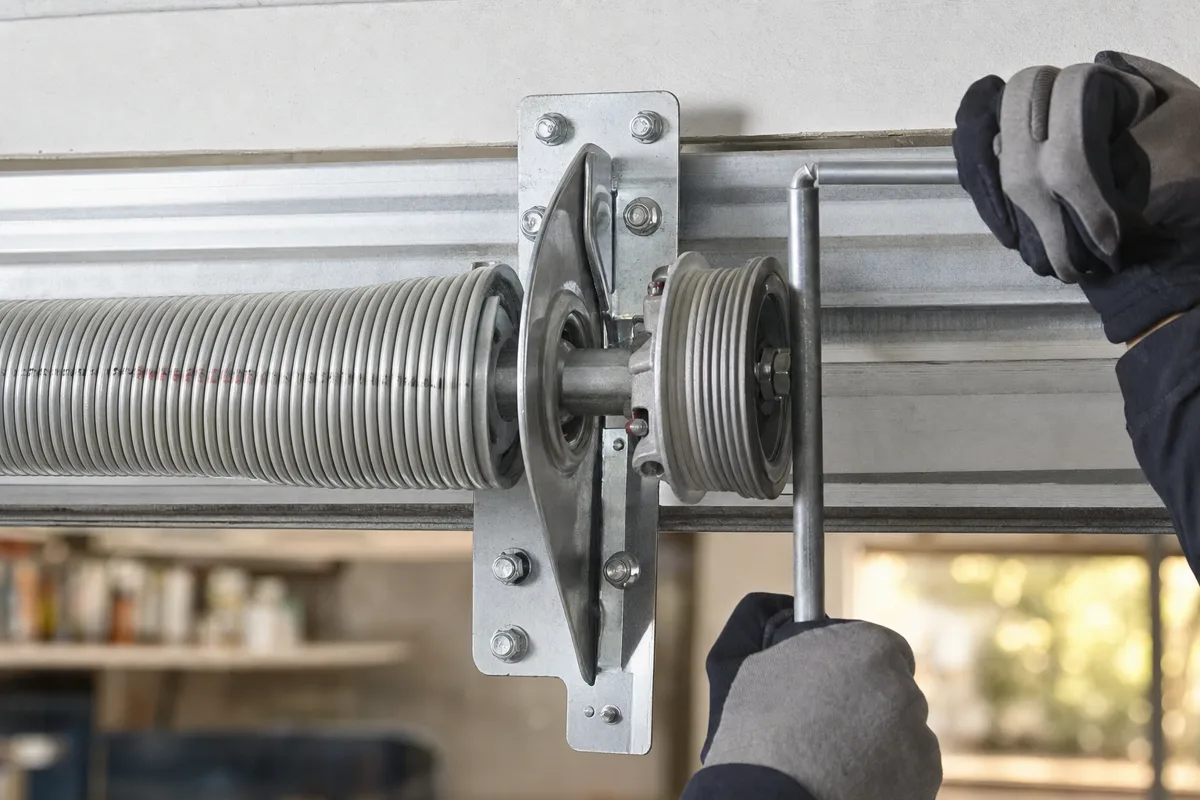

Garage Door Spring Replacement
Failed springs replaced in matched pairs and re-tensioned to the actual door weight.
View serviceA broken spring turns a manageable door into its full dead weight in an instant, and on a wide double that is a great deal of steel.
Look at the spring above the door, on the shaft. A clear gap in a coil that should be continuous, or two separated halves, is a break and it is unmistakable. Other signs are a door that will not lift or rises a few inches and stalls, a loud bang from the garage, a leaf that has become far too heavy by hand, and an opener that strains then reverses. Do not use the door, and do not pull the release to lift it manually.
The counterbalance system is what makes a garage door movable. Springs store energy as the door comes down and give it back as it goes up, so a correctly balanced leaf feels light enough for one person to lift and stays where it is left. Remove that and the door is simply its own weight, which on the wide double doors that dominate Burlington's housing stock is substantial. Recognising a failed spring matters for two reasons. First, the symptoms are distinctive enough that you can identify it from the driveway without touching anything. Second, almost everything people instinctively do next, pulling the release, lifting harder, holding the button down, is exactly what turns a spring replacement into a bent door, a cable off its drum or a stripped operator.
Start at the top. The early checks are the most common causes and need no tools.
Stand well back and look at the spring or springs on the shaft above the opening, using a torch. A broken torsion spring shows a clean gap of one to two inches where the coil has separated, usually near a cone. This is the clearest single indicator on the whole door.
What it means: A visible gap is a definitive break. Stop here and leave the door alone.
A spring failure is loud, and people usually describe a bang like a heavy tool hitting concrete, sometimes heard from inside the house. If that sound was followed by a door that would not open, or by an opener that ran and lifted nothing, the two events are almost certainly the same event.
What it means: A bang followed by a door that will not lift is a spring until proven otherwise.
An operator asked to lift an uncounterbalanced door will strain, hum, move the leaf a few inches, then stop or reverse and often flash a diagnostic pattern. Some units will lift a light single door partway and then trip out. Do not keep trying: each attempt loads the drive it was never meant to carry.
What it means: A motor that runs hard and moves nothing points at counterbalance, not at the motor.
If no gap is visible and nothing looks damaged, and the door is fully closed, disconnect the operator and lift the door by hand. A correctly balanced door moves without great effort and holds position when left halfway. One that crashes down or shoots up has lost its balance even without a clean break.
What it means: A door that will not hold position halfway needs spring work whether or not a coil has parted.
A spring letting go moves load somewhere. Check for a slack or unwound cable, a leaf sitting out of square, rollers pulled toward the edge of the track, and a bottom bracket that has shifted. Photograph what you see from a safe distance and send it with your request.
What it means: Collateral damage changes the parts needed, so recording it saves a second visit.
This is the part of a garage door where stored energy is genuinely dangerous. Do not attempt to wind, unwind, adjust or remove a spring: it takes the correct winding bars and the correct calculation, and the failure mode is an injury rather than a broken part. Do not pull the emergency release on a door with a failed spring, because the leaf will then be held by nothing and can drop under its own weight. Keep hands away from cables, drums and bottom brackets, which stay under tension even with the door open, and keep children and vehicles out from underneath the door entirely.
Burlington's spring failures are shaped by width and by season. This is a city of double garages, documented explicitly in Tyandaga, where most homes have a double garage on large properties with double-lane driveways, and in Millcroft, Headon Forest and Shoreacres, and a wide leaf loads its springs harder than a narrow one. Timing follows the cold: with a January daily mean of minus 4.4 degrees, grease thickens, bearings stiffen and spring output drops slightly, so the door needs more effort exactly when the spring has least margin left. Age concentrates it further, since 67 percent of Tyandaga's dwellings and 62 percent of Brant Hills' date from 1961 to 1980, and much of that original hardware has long since passed its rated cycles.
Fill out the form and we'll confirm your appointment by email.
These guides are written for Burlington homes. If the fix is beyond a homeowner check, we work everywhere inside this area.
Map data © Google. Pin shows the service area, not a walk-in location — all work is done at your home.

A real callout, not stock imagery.
A sectional door pulled off its tracks, taken down and supported on site so it could be checked and re-hung safely — photographed on the job.
