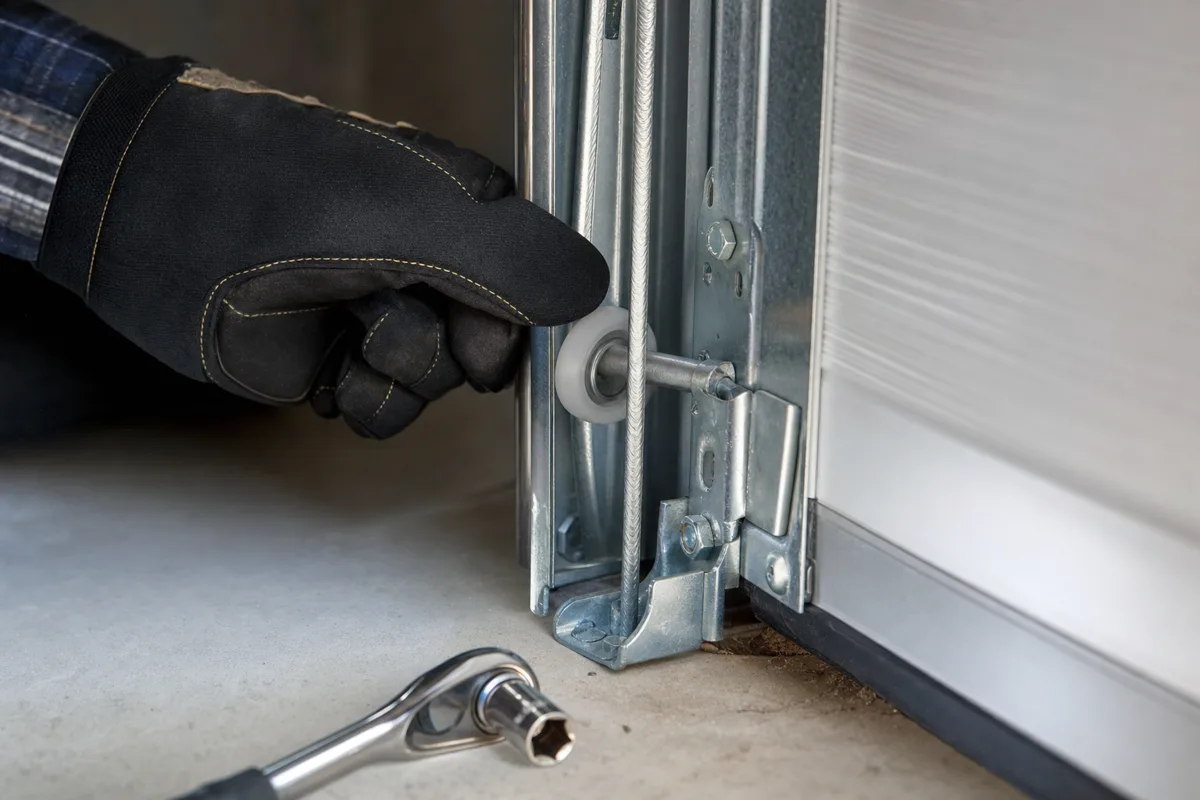

Emergency Garage Door Repair
Urgent attention for doors stalled mid-travel, jammed shut or hanging crooked.
View serviceA door off its track is being held by hardware that was never meant to hold it. The first correct action is to stop.
Stop using the door and disconnect power to the operator so nobody presses the button. Do not try to lever the door back into the track, because the leaf is still under spring tension and can shift or drop. Move vehicles out of the path if that can be done without going under the door, keep children and pets away, photograph the position from a safe distance, and describe where the door has stopped and what is bent when you book.
When rollers leave the channel, the door stops being a guided assembly and becomes a heavy panel resting on whatever has not yet bent. That matters more in Burlington than in cities with narrower doors, because so much of the housing stock here runs wide doubles: the leaf is heavier, the span is longer, and a door out of square in one corner puts real force through the opposite track, the cables and the sections. The instinctive response, cycling the operator to see whether it corrects itself, is the single most damaging thing available. Each attempt drags rollers further out, bends more track, and can pull a cable off its drum, converting a realignment into a rebuild.
Start at the top. The early checks are the most common causes and need no tools.
Unplug the opener or switch off its circuit so no one can try again out of habit, which is easily the most common way a bad situation gets worse. Do not pull the emergency release: on a door out of square with unknown spring and cable condition, that removes the only thing holding it.
What it means: Isolating power prevents the second attempt that causes most of the damage.
Standing to one side rather than underneath, look at which rollers have left the track, whether the leaf is leaning inward or outward, whether either cable is slack or unwound, and whether a spring shows a visible gap. Photograph all of it in reasonable light.
What it means: Slack cable or a gapped spring means a counterbalance failure caused the derailment.
Move bikes, bins and anything else out of the door's path, and get vehicles clear only if that is possible without passing underneath the leaf. If a car is directly under a door held at an angle, leave it there and say so when you book.
What it means: Nothing of value, and nobody, should be under a door in this condition.
Check the vertical track for an impact dent at bumper height, look for a seized roller with a flat spot, check whether track brackets have loosened from the wall, and note whether the door had been binding or making new noises in the weeks before.
What it means: Impact, a seized roller, loose brackets or a cable failure explain nearly all derailments.
Record the height at which the door stopped, whether it was opening or closing, what you heard, which corner dropped, whether a vehicle is inside, and the driveway approach. On short-driveway streets, mention it, because staging space affects how the work is planned.
What it means: A clear description determines what hardware arrives on the first visit.
A door off its track is one of the genuinely hazardous states a garage door reaches, because the load has already moved somewhere it was not designed to go and the remaining hardware may be holding more than it is rated for. Do not lever, hammer or pry the leaf back toward the channel, and do not put hands into the track, near a drum or near a bottom bracket. Do not pull the release. Springs and cables stay under tension even with the door open, and a bottom bracket or a partially unwound cable releasing under load moves fast enough to cause serious injury.
Derailments in Burlington have a geography. Short driveways are the biggest single factor, and Alton Village and The Orchard were both built with them: Alton is described as two-storey homes with small yards, short driveways and built-in double-car garages, which leaves little margin between a bumper and a closed door. Age is the second factor, since a great deal of guide hardware from the 1961-to-1980 wave is still in service in Brant Hills, Tyandaga and Mountainside, and a seized roller on a worn track derails long before a new one would. The third is winter: a door forced against a seal frozen to the slab, which the local pattern of daytime melt and overnight refreeze produces regularly, is a classic way to pull rollers out at the bottom of the leaf.
Fill out the form and we'll confirm your appointment by email.
These guides are written for Burlington homes. If the fix is beyond a homeowner check, we work everywhere inside this area.
Map data © Google. Pin shows the service area, not a walk-in location — all work is done at your home.
A real callout, not stock imagery.
A sectional door pulled off its tracks, taken down and supported on site so it could be checked and re-hung safely — photographed on the job.
