
Emergency Garage Door Repair
Urgent attention for doors stalled mid-travel, jammed shut or hanging crooked.
View serviceA door frozen to the floor is not stuck, it is glued. The mistake is treating it as an obstruction and asking the motor to win.
Stop using the operator immediately. Break the bond rather than the door: work along the bottom seal with warm, not boiling, water, use a plastic scraper or a rubber mallet gently along the seal line to crack the ice, and clear snow and slush away from the full width of the opening. Once the door opens, dry the slab and the seal, then look at where the water is coming from. Never lever the seal with a metal blade and never hold the button down.
Freezing shut happens because water sits under the bottom seal and then turns to ice, bonding a flexible rubber strip to a concrete slab. It is not a fault in the door. What causes damage is the response: holding the button down, lifting hard, or repeatedly cycling the operator. Any of those puts the full effort into the bottom section and its hardware, and the result is a bent panel, torn weatherstrip, a cable jumped off its drum or a stripped drive gear in the opener. Burlington's winter makes this particularly likely rather than particularly severe. The January average high here is minus 0.6 degrees and the daily mean is minus 4.4, so the ground in front of a garage thaws in the afternoon and refreezes overnight through much of the season, which is exactly the pattern that builds ice at a threshold.
Start at the top. The early checks are the most common causes and need no tools.
If the operator ran and the door did not move, or moved and reversed, do not try a second time. Go to the bottom of the door and look along its full width for a continuous ice line, a frozen puddle at one corner, or packed snow pressed against the seal from outside.
What it means: A visible ice line at the seal means the bond is the problem, not the door.
Shovel snow and slush back from the whole width of the door and a good arm's length beyond it, including any ridge left by a plough or by clearing the driveway. That ridge is often the source of the water that refroze against the seal.
What it means: Clearing outside removes both the obstruction and the next thaw's water supply.
Pour or sponge warm water along the seal line, working from one end to the other, and give it a minute to work. Do not use boiling water on cold concrete, and do not use a heat gun or open flame anywhere near the seal, the sections or the wiring.
What it means: Warm water along the seal releases most frozen doors within a few minutes.
A plastic scraper worked flat along the joint, or light taps from a rubber mallet along the bottom section, will crack a thin ice bond. Never insert a screwdriver, chisel or metal blade under the weatherstrip, which tears it and creates the gap that lets more water in next time.
What it means: A plastic edge cracks ice without cutting the seal that is keeping water out.
Once the door is open, dry the slab and the seal, then check the seal for hardening, splits and missing sections, look at the bottom brackets and the lowest inches of both cables for rust, and work out whether the driveway drains toward the opening or away from it.
What it means: The seal condition and the drainage direction together explain why it froze.
Stop entirely if the door is out of square, if a cable has gone slack, if you can see a gap in a spring coil, or if any part of the bottom section is visibly bent. Those mean a forced attempt has already caused damage, and further attempts will add to it. Do not use a heat gun, blowtorch or propane heater near the door: the sections, the seal, the low-voltage sensor wiring and in many Burlington garages the stored items alongside them are all flammable or heat-sensitive. Do not hold the operator button down in the hope that the ice gives first, because it usually will not.
Burlington freezes shut for a different reason than the snowbelt does. Seasonal snowfall here is 99.9 centimetres over 25.5 snowy days, the lowest total among the lakeshore and inland cities in this part of Ontario because Lake Ontario moderates the climate, so the issue is not depth of snow but the frequency with which the temperature crosses zero. A January average high of minus 0.6 degrees against a daily mean of minus 4.4 describes exactly that. Grade decides who suffers most: in Brant Hills, on sloping streets shaped by hilly escarpment terrain, and in Mountainside as the land rises toward the escarpment, driveways frequently fall toward the garage, so every thaw delivers water to the one place it must not freeze.
Fill out the form and we'll confirm your appointment by email.
These guides are written for Burlington homes. If the fix is beyond a homeowner check, we work everywhere inside this area.
Map data © Google. Pin shows the service area, not a walk-in location — all work is done at your home.
A real callout, not stock imagery.
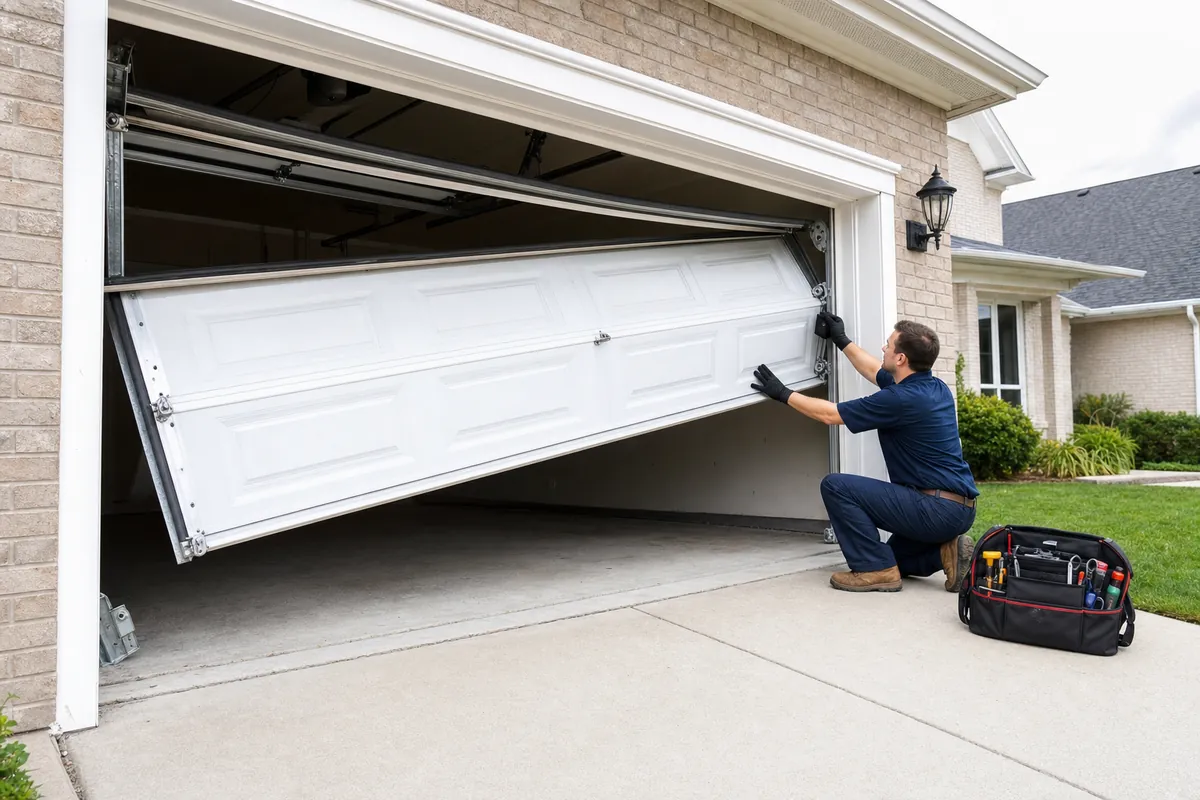
A sectional door pulled off its tracks, taken down and supported on site so it could be checked and re-hung safely — photographed on the job.
